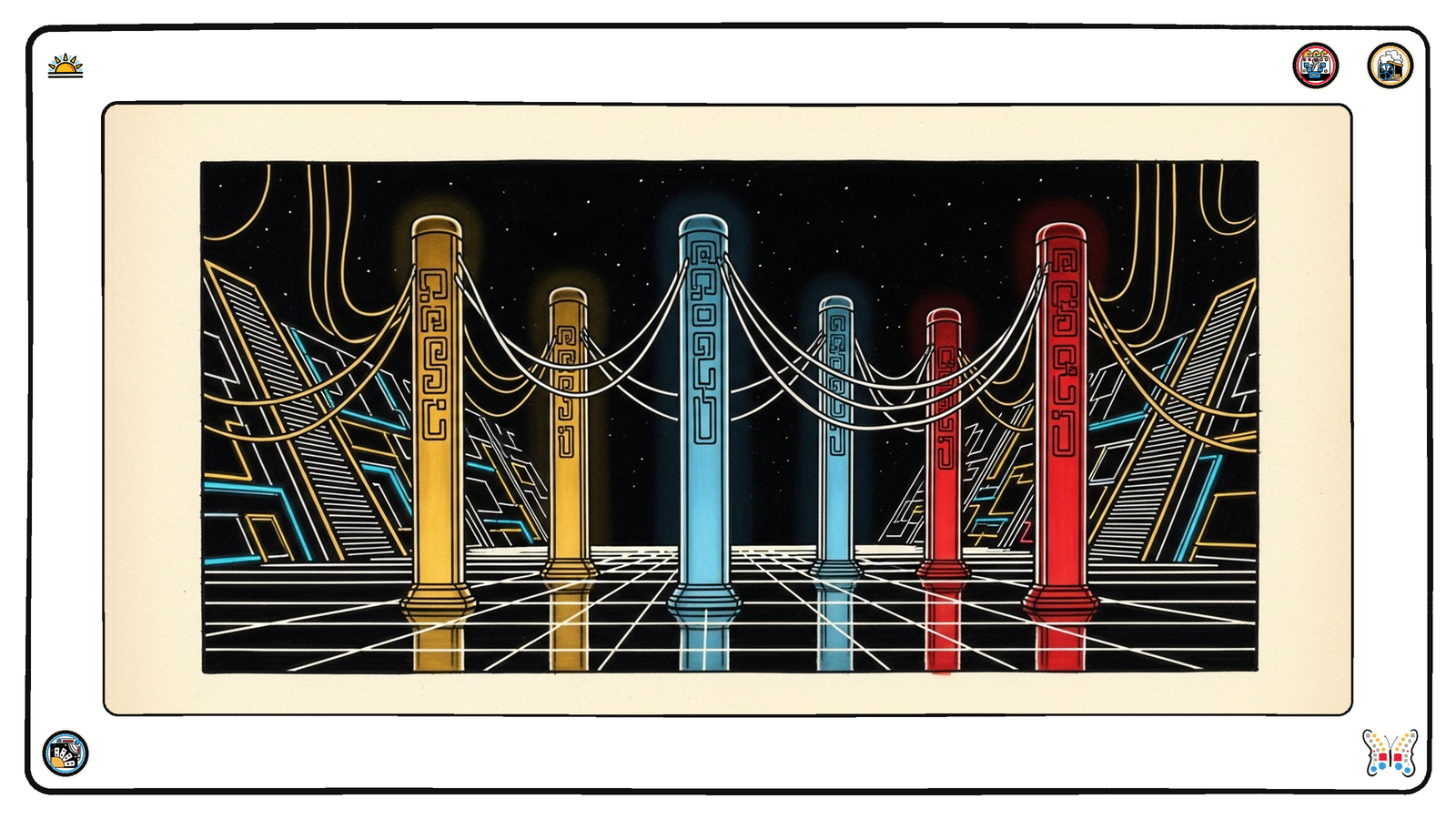
Governance is not a list of rules — it is a stack. A machine rule enforces a written policy, which is explained by a piece of guidance, protects a consumer experience, carries a provenance, and applies at a point in the API lifecycle. When those links exist, governance is legible; when they break, it is just noise. So we built API Governance Graph to bind all six building blocks into one navigable graph — and make the breaks impossible to miss.
Three Views of One Stack
The tool renders the same governance stack three ways, all client-side with no backend and no account:
| View | What it shows |
|---|---|
| Stack | Every node in six columns — Guidance, Policy, Rule, Provenance, Experience, Lifecycle. Click any node to light up everything bound to it and open a detail rail you can keep walking from. |
| Gaps | The loose ends, scored per layer: rules no policy enforces, rules tied to no experience, policies with no stated why, policies enforcing rules absent from the executable catalog, and guidance nothing points at. |
| By experience | The whole stack rolled up by the experience: axis — the one that answers what does turning a rule on actually buy the consumer. |
Stack makes governance legible. Gaps is the view that turns “we have governance” into “here is where it is thin.”
An Explicit Join Spine, Not Fuzzy Matching
The graph is assembled at build time from two sources we already maintain and shipped as a single static snapshot (graph-bundle.json), so the app has no runtime dependencies and makes no network calls. It draws on the API Commons rule catalog — the full 769-rule, twelve-format ruleset with each rule’s tags, source provenance, and given/then — and the apievangelist.com building blocks: the policies, guidance, experiences, lifecycle, properties, and strategies collections, joined by their published cross-link arrays.
The join is declared, not guessed. A policy names the rule slugs it enforces, points at the guidance that explains it, and lists the experiences it improves; a rule carries its own experience: tags and its source lineage. The graph simply renders what is already true in the data — which is why the Gaps view can be trusted to name real holes rather than artifacts of a matcher.
API Governance Graph is one of the API Commons tools, and like the rest it is open, portable, and static under the hood — free to fork, with expert governance services available when you want the stack mapped for a real organization. This is part of a series introducing the tools one at a time.